Website Subscription vs Buying a Website: Which Is Better for a Local Business?
Key Points
- A website subscription spreads the cost and bundles hosting and updates, while buying costs more up front and leaves you running the site.
- The deciding questions are what you own if you stop paying and how many months it takes for buying to cost less.
- Your domain, your content, and a full copy of the site files are the three things to confirm in writing either way.
- Neither option is better for every business. The right pick depends on cash, time, and how much you want to handle yourself.
Introduction
Website subscription vs buying a website comes down to two questions: what you own if you stop paying, and how many months it takes for buying to cost less. A subscription spreads the cost and bundles upkeep. Buying costs more up front and leaves you running the site.
Owners see a monthly price on one side, and a lump sum on the other, and most of what is written about it comes from companies that sell one of the two.
Outrank Strategy sells a monthly plan, so this guide gives you the math and a contract checklist to test any offer, ours included. It covers what you own, the break-even calculation, contract terms to demand, and who each option fits. For cost ranges, see how much a small business website should cost.
Website Subscription vs Buying a Website: What Is the Real Difference?
With a subscription, you pay a monthly fee for design, hosting, and updates, usually under agreed terms. When you buy, you pay a build fee once, then cover hosting, updates, and changes yourself or pay for them separately. A website company that handles design, hosting, and updates is selling the first model.
A subscription typically bundles the domain, security, backups, and a set amount of update time. A purchase typically covers the build, with hosting and edits priced separately.
Most “rent vs own” articles come from firms that sell one side, and their figures are often undated or unsourced.
What Do You Actually Own With Each Option?
Ownership is three separate questions: your domain, your content and design, and the files behind the site.

Your Domain Name
Your domain is the address customers type. ICANN’s registrant guidance puts responsibility on the registrant: you must keep contact details accurate and your registrar account and payment details current. Ask that your business, not the company, is named as registrant.
Moving a domain has rules. ICANN’s transfer FAQ says a registrar may deny a transfer within 60 days of initial registration, and you cannot transfer within 60 days of changing the registrant name, organization, or email, so fix the registrant early, not on your way out. You also need an authorization code to move it.
Your Content, Photos, and Design
Ask whether your text, photos, logo, and page layouts are yours to take, and whether the design relies on licensed themes or plugins that could stop working when the company’s license ends. Rights depend on the contract, so get the answers in writing.
Your Hosting and Files
A WordPress site moves by copying its files and database to the new host. The official migration guide warns that references to the old domain can remain in the database and cause link or theme problems. Ask who does the move and what it costs.
How Long Until Buying a Website Costs Less Than a Subscription?
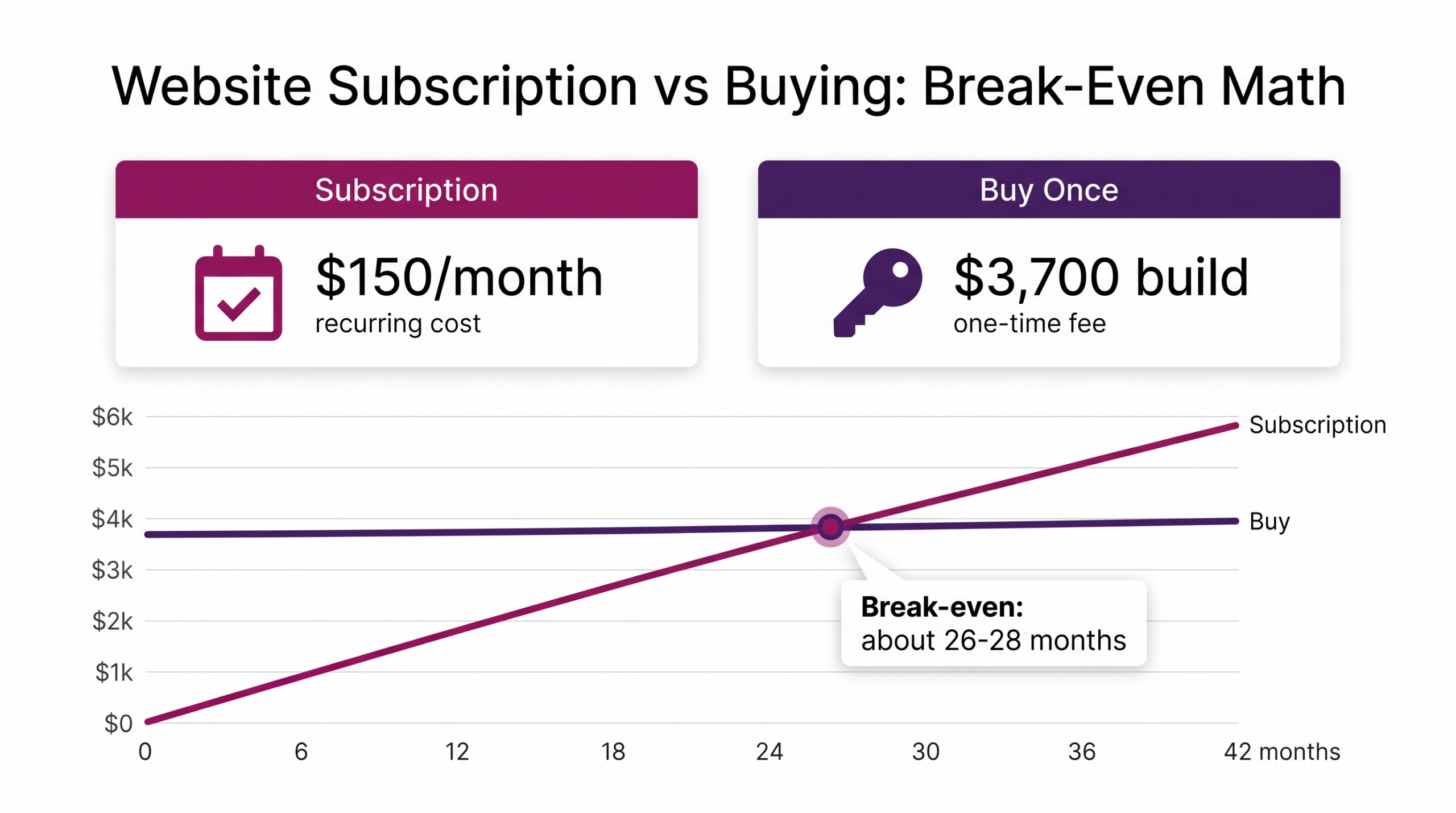
Buying costs less once the one-time build fee, spread over the months you own the site, drops below the monthly fee minus what you would pay yourself for hosting and updates. Here is the calculation:
- Get the one-time build quote.
- Add what you would pay for hosting each month.
- Add what you would pay for updates (hours times the hourly rate).
- Subtract steps 2 and 3 from the monthly plan price.
- Divide the build quote by that result. The answer is your break-even in months.
For an illustrative example, take a $3,700 build, the agency average in one cost guide. One provider’s WordPress hosting in the same guide runs $84 to $192 a year, about $7 to $16 a month. Against the $150 Managed Hosting price on the pricing page, break-even is 3,700/(150 – $16), about 27.6 months, or 3,700/(150 – $7), about 25.9 months with cheaper hosting. That is roughly 26 to 28 months before paying for any updates. Each paid hour pushes it later.
The math leaves out your own time, security work, an eventual redesign, and whether the build and the plan include the same things. Use it to compare, not to decide.
What Should a Website Company That Handles Design, Hosting, and Updates Put in Writing?
The agreement should say what you can take with you, what it costs to leave, and what “updates” means. Check these six items:
- Term and renewal: the length, automatic renewal, and the notice period.
- Price changes: whether the monthly fee can rise, and with how much notice.
- Exit terms: whether you can take a full copy of the site, and any buyout or handover fee. No standard buyout price exists, so get the number in writing before you sign.
- What “updates” includes: hours per month, turnaround time, and whether unused hours roll over.
- Logins and registrant: who is named on the domain, and who holds the hosting and analytics logins.
- Cancellation: what is shut off, and when.
Benefits and Trade-Offs of Each Option
- A subscription gives you a low upfront cost, upkeep and security handled, a steady monthly bill, and someone to call. The trade-offs are a higher total over several years, possible limits on what you can take, and commitment terms.
- Buying gives you a lower cost over a long stretch, the files in your hands, and freedom to change providers. The trade-offs are a larger up-front bill, handling or buying updates and security, and risk if the builder disappears.
If you need a better website but do not want to spend thousands of dollars upfront, your options are a monthly plan, staged freelancer payments, or a builder you manage. The details are in our guide to what a small business website should cost.
Subscription vs Buying: Side-by-Side
| Subscription | Buying | |
|---|---|---|
| Upfront cost | Low or none | Build fee, paid once |
| Monthly cost | Fixed fee | Hosting, plus updates you buy |
| Updates and security | Handled by the company | Handled by you, or paid for |
| If you leave | Depends on the contract | You keep the files, if the contract says so |
| Flexibility | Limited by the terms | High |
| Best fit | Little cash, no time for website chores | Cash on hand, long-term plans |
Contract terms can change every row, so read the agreement.
Which Is Better for a Local Service Business?
A subscription tends to fit a small crew that wants no website chores and has little cash to spare. Buying tends to fit a business with cash, someone who can handle edits, or plans to keep one site for years. For some owners, a builder they manage beats both.

A one-truck Oregon electrician pays a monthly plan, so someone else handles updates and security. The key step was confirming in writing that the domain was registered to the business.
A Utah restoration company with several crews buys its site outright and pays for a small care plan. The break-even math showed it came out cheaper after about two and a half years, and it wanted the freedom to switch providers.
Both examples are illustrative, not documented client results.
Who Can Build a Website for My Local Business?
Four routes exist: a website builder you run yourself, a freelancer, an agency, or a managed provider that bundles hosting and updates. Each fits a different mix of cash, time, and control.
How to Vet the Best Website Company for Local Service Businesses
The best website company for local service businesses, and the best website designers for home service companies, share three traits: trade sites you can actually see, plain-language terms, and clear exit rights. When reading reviews of website companies for small businesses, look for ones that mention the handover or exit, not just launch day. Outrank Strategy’s Portfolio page shows real clients by name and trade, though not yet before-and-after numbers.
Practical Tips for Website Subscription vs Buying a Website
On the question of website subscription vs buying a website, four habits protect you either way.
- Ask for the registrant name before you pay. Your business should be listed, not the company.
- Request a full backup now, then every year.
- Set a reminder for your break-even month. Revisit the decision then.
- Treat a refusal to put exit terms in writing as an answer.
Conclusion: Website Subscription vs Buying a Website
Website subscription vs buying a website has no single winner. The right choice depends on what you can take with you and how many months you will keep the site, which is why the break-even steps and the contract checklist matter more than the monthly price.
Want a second opinion on a quote or a contract? Book a free strategy session and Outrank Strategy will look at it with you. Next in this series: fixing a website that looks old.